
Why I do Space
A young boy's dream to explore the stars and help move humanity forward.

I remember standing on the dust-red plains of Baikonur when I was five years old. My father, a rocket engineer, took me to see a launch.
Most people who witnessed it talk about the sound, the bone-shaking roar that rattles your chest and makes your ears ring for hours. But what stayed with me was the silence afterward. The way the Earth suddenly feels small and quiet once several tons of steel and fire have punched a hole through the ceiling of the world.
At that moment, I understood something. The sky isn’t a barrier designed to keep us in. It’s a frontier we’ve finally learned how to reach.
People often ask me why I do this. Why dedicate a life to the cold, unforgiving vacuum when our own planet is loud with immediate, visceral problems?
It’s a fair question. Usually, people expect a “CEO answer,” something about market share, orbital logistics, or the growth rate of the satellite industry.
But the truth is much simpler, and much deeper.
I do space because I’m a romantic who wants to make our lives better through engineering. I do it because the best way to solve the riddles of Earth is, ironically, to step back far enough to see the whole puzzle.
Let me show you what I mean.
Curing the Incurable
Let’s start with the things that kill us.
On Earth, medical research fights gravity. When scientists try to grow a tumor in a petri dish to test a new drug, gravity flattens it. It doesn’t behave like a real tumor inside a human body. The cells grow incorrectly. The data becomes less reliable.
But in space, biology works differently.
In the microgravity of Low Earth Orbit (LEO), cancer cells grow into more realistic 3D structures. They grow faster, and they grow “truer.” More like the tumors actually threatening human lives. By exposing these cells to the unique radiation environment of space, we can stress-test treatments in ways that are physically impossible on the ground.
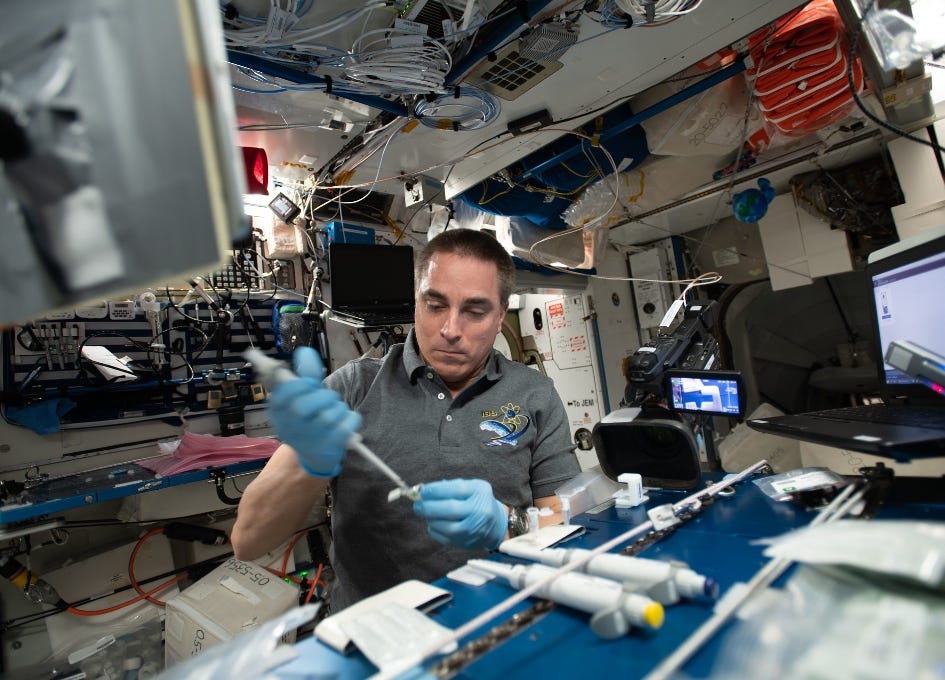
We aren’t just floating around up there. We’re accelerating the cure for diseases that have plagued humanity for centuries.
The breakthrough for the cancer that took your grandmother? The treatment for Alzheimer’s that threatens your future? They’re probably waiting for us in a pressurized module 400 kilometers above your head.
Zoning the Planet
Here’s an uncomfortable truth. We treat Earth like a factory floor, then wonder why the air is dirty and the rivers are toxic.
This is insane.
Earth is a garden. It’s a biosphere, a living, breathing system that took billions of years to balance itself. In real estate terms, it’s zoned residential. It was never meant to be a heavy industrial park.
The solution to pollution isn’t just better filters. It’s moving the smokestacks to space, where they can’t harm us.
We should be doing our heavy manufacturing in orbit. Smelting steel, processing rare earth metals, generating baseload power. In space, you have 24/7 access to solar energy that is several times more intense and uninterrupted than it is on the ground. You have a perfect vacuum for manufacturing high-purity alloys and flawless fibre optics.
We can strip-mine asteroids (dead rocks with no ecosystems to destroy) rather than strip-mining the Amazon.
Take the dirty work off-world. Turn Earth into what it should be: a park.
The Finite and the Infinite
We live on a planet with finite boundaries.
Finite lithium. Finite land. Finite room to grow without stepping on each other’s toes.
Humanity has always thrived when there was a frontier. The frontier is a pressure valve. It’s where the dreamers, the misfits, and the explorers go to try new ways of living. When a society loses its frontier, it turns inward. It becomes stagnant and obsessed with dividing an ever-shrinking pie.
Space offers us an infinite pie.
I envision a world where space travel is as common as civil aviation, with thousands of people entering orbit every year. That shift (from space being a “government project” to being an extension of human civilization) is the most profound transition of our century.
It’s not about escaping Earth. It’s about giving humanity room to experiment, to fail, to dream without limits.
A School of Survival
Space forces us to grow up.
On Earth, we’re sloppy. We dump plastic in the ocean because the ocean is big and we think it goes “away.” We waste water because it falls from the sky. We treat resources like they’re infinite because, for most of human history, they felt that way.
In space, there is no “away.”
If you don’t recycle close to 98% of your water, air, and waste on a spaceship, everyone dies. The mission fails. Space is the strictest teacher in the universe. It demands a true circular economy.
And here’s the beautiful irony. The technologies we develop for survival in space become the solutions we need on Earth.
The water filtration technology we build for a lunar base is the same technology that will save a drought-stricken village on Earth. The closed-loop agriculture we invent for Mars is exactly what we need to feed 10 billion people on Earth without destroying the soil.
Space isn’t a distraction from Earth’s problems. It’s the toolbox we need to fix them.
Building 2049
Last month, Chinese scientists released a document that has been lingering in my thoughts: Tech Predictions and Future Visions 2049. It’s a roadmap compiled by leading researchers from institutions like Huawei, the Shanghai AI Laboratory, and Tencent. A collective attempt to paint what humanity could achieve by 2049.
The document outlines ten technology visions. Artificial superintelligence amplifying human cognition. General-purpose robots in every home. Flying cars navigating AI-managed cities. Fusion energy turning households into miniature power stations. Molecular medicine enabling “programmable health.”
But it’s Vision 10 that I find most interesting: humanity moving seamlessly between land, space, and deep sea, entering what they call a “multi-domain cohabitation era.”
This isn’t science fiction. It’s a serious forecast from some of the world’s most respected scientists about where we’re heading. A future where space isn’t a distant dream but an integrated part of human civilization.
When I read this document, it immediately resonated with me. This is exactly the future I’m working to enable. Every rocket we launch, every orbital platform we build, every closed-loop life support system we perfect. These aren’t just engineering achievements. They’re the building blocks of that 2049 vision.
Space is one of the fundamental pillars that make everything else possible. The clean energy from fusion reactors? It is powered by Helium3 mined on the Moon. The carbon-neutral economy? Metal mining and hazardous manufacturing are moved away from Earth. Ubiquitous autonomous cars and robots?
Tens of thousands of low-Earth orbit satellites serve as nodes in an intelligent space-air-ground-sea integrated network.
I do space because I want to be part of building that future. Not just imagining it, not just writing about it, but actually constructing the infrastructure that makes it real. Space is my medium. The way a sculptor works with clay or a programmer works with code. It’s the domain where I can make the most meaningful contribution to humanity’s next chapter.
And what excites me most is that this isn’t a solitary vision. Scientists across continents, institutions, and disciplines are converging on similar conclusions. Whether it’s the Chinese roadmap to 2049, NASA’s Artemis program, or private companies building reusable rockets, we’re all pulling in the same direction. We’re all building toward the same abundant, expansive, multi-domain future.
I’m honored to contribute to this vision. Every day I get to work on the systems that will make “multi-domain cohabitation” not just possible, but inevitable.
The Final Horizon
We often talk about space as the “Final Frontier,” but that implies an endpoint. I prefer to think of it as the beginning of our adulthood.
For thousands of years, we’ve been a species confined to a nursery, looking out through the slats of our cradle at the lights on the ceiling. We’ve pointed at the stars, made up stories about them, and wondered what they were.
Now, for the first time in history, we can actually go there.
I don’t do space because I’ve given up on Earth. I do space because I refuse to believe that the human story ends here, on a single point of failure in a vast universe.
We’re standing at the edge of a second Renaissance. One where the “Old World” is a planet and the “New World” is the solar system. As we move outward, we aren’t leaving our humanity behind.
We’re finally giving it enough room to breathe.
I’ll leave you with a thought from the philosopher Konstantin Tsiolkovsky, which I keep close to my heart:
“The Earth is the cradle of humanity, but mankind cannot stay in the cradle forever.”
We’ve spent enough time in the cradle.
It’s time to stand up, look at the stars, and start exploring what’s out there.
If only we could finally solve the problems we have down here. Space costs money, and it is competing with things like healthcare, education, and infrastructure. Space exploration perhaps helps research in some of these areas, as you've mentioned, but it is hardly cost-effective.